Friday, December 2, 2016

Veeranam Lake, Cuddalore

Veeranam Lake (Veeranaaraayanapuram Lake) is located 14 km (8.7 mi) SSW of Lalpet in Cuddalore district in the state of Tamil Nadu in South India. 1 km (0.62 mi) from Sethiyathope. The lake located 235 km (146 mi) from Chennai, India, is one of the water reservoirs from where water is planned to be supplied to Chennai.
The Veeranam project, to supply water to Chennai, was conceived in 1967 by the then Chief Minister of Tamil Nadu, C. N. Annadurai, and executed under his successor, M. Karunanidhi. The project was subject to rampant corruption and money earmarked for the project was lost leading to stagnation of the project. The project's completion in 2004 was a major political victory for the AIADMK government of the time due to the project's long history of corruption and politicking. Ironically it was impossible to use any water from the lake since it had run dry, and the face-saving proposal adopted by the authorities was to dig 45 deep borewells around the area and pump the resulting water 235 km (146 mi) to Chennai via the pipeline.

Climate
Like most of coastal Tamil Nadu, the areas adjoining Veeranam tank has a sub-tropical climate receiving most of the rainfall during the North-East monsoons from Oct - Dec. Hot weather prevails in the summer months from March to June, and the maximum temperature varies from 30–38 °C. Being close to the coast cyclones that strike the area have a profound impact, resulting in heavy rains. 

Two rainfall monitoring stations are located in Veeranam Tank one at its right bank i.e. Kattumannarkoil and another at left bank i.e. Sethiyathope. The average rainfall in these stations is more than the state average of 950 mm. During the last 18 years the average annual rainfall in Kattumannarkoil is 1025 mm. In Sethiyathope, the average annual rainfall during the last 25 years is 1273 mm. But due to the vagaries of the North-East monsoon, Veeranam tank often has to depend on water from Mettur dam.
History 
Veeranam Tank is one of the biggest tanks in Tamil Nadu and also an age old one. This tank has been referred briefly in the book called “Ponniyen Selvan” Written by the famous author ‘Kalki’ in the year 1950. This book gives the information on the age of this tank and it has been mentioned that the tank was formed at a period of more than 1000 years by the Prince Rajathithar Son of Paranthaka Chola. The tank was originally called as Veeranarayanan Tank.
When king Paranthaka Chola I ruled over Chola Kingdom during the 10th century i.e. 907 to 935 AD he wanted to improve the Irrigation facilities in and around Chidambaram. He formed a village called as ‘Veera Narayana Sathurvethi Mangalam. This Village was gifted to the Scholars who were well versed in the Four Vedas. This Village is now called as Kattumannarkoil which is situated in the right flank of Veeranam Tank. He then formed the biggest tank and named it as ‘Veera Narayanan Eri’ ‘Veera Narayanan’ is the nickname given to king Paranthaka Chola I for his Valour. Subsequently this tank is now called Veeranam Tank.


During the later period of Chola Kingdom, King Rajendra Chola I who ruled during the period 1012 AD to 1044 AD, Spread his kingdom up to Ganges. He conquered the lands up to River Ganges. In Memory of his Victory he formed the Village ‘Gangai Konda Cholapuram’ during the year 1024 AD. In addition to that in order to improve the Irrigation facilities in and around the new Village, he formed a new tank and called it as ‘Chola Gangam’. He made a link between ‘Chola gangam’ and Veeranarayanan Eri so that the former surpluses into the later. The tank ‘Chola Gangam’ is now called as ‘Ponneri Tank’ which is situated at the road connecting Jeyamkondam and Gangaikonda Cholapuram. These details were collected from Saraswathi Mahal Library at Tanjore.
Veeranam Lake and water resources
Veeranam Lake is a major tank attached to Chidambaram Division of South Arcot. PWD circle and the Lalpet Section of PWD is in charge of the maintenance and operation of irrigation systems of this tank.

Padaleeswarar Temple, Cuddalore

Pataleeswarar Temple is a Hindu shrine dedicated to Lord Shiva in the town of Cuddalore. It was constructed during the Pallava and Medieval Chola periods.
The Saivite saint Appar is believed to have adopted Saivism at this temple.
There is a belief/myth that by worshiping this God single time is equal to 16 times worshiping the Shiva in Kasi, 8 times in Thiruvannamalai and 3 times in Chidambaram.
Once,  Lord Shiva and Parvathi were playing the game of dice. Though Parvathi won every time, the LORD could not accept it.  The Lordess said that she will cover the eyes of Shiva and to check if he really can win. . Thus saying she covered the eyes of the Shiva. The whole world plunged into darkness. A few seconds in this situation, seemed infinite time for Gods. Gods felt this darkness as  a long duration of inactiveness.


Parvathi on  realising that she has committed a mistake,  prayed for forgiveness. Lord Shiva advised the Lordess to go to earth and pray in all the 1008 shiva sthalas and in whichever sthala the left eye & shoulder vibrates, there the penance should be performed by her. Accordingly, in the course of sthala yatra of  Parvathi, when she came to pray in this sthala (Thirupadhiripuliyur Padaleeswarar temple) the diving occasion of vibration of left eye and left shoulder happened. Lordess  also penanced in the Aruba(formless) form (Arunthava nayagi) and married Lord Shiva.

The name "Thirupadirupuliyur" has been  derived from the holy tree of the temple - Padiri.
During the period of “King Mahendravarman” (600-630) “Thiru Navukkarasar” (Appar) was tied to a stone and thrown into ocean. “Appar” praised “Lord Shiva” and composed hymns on him. “Lord Shiva” was pleased with his prayers and the stone started floating like a boat and “Appar” reached the shore safely. Even now the place, where he landed on shore known as “Karayeravitta Kuppam” is there as witness.


Son of “Madiyanta Muni” worshipped “Lord Shiva” IN this place. He requested “Lord Shiva” to bless him legs and hands like tiger, to climb the Padiri tree. There after he was known as “Pulikkaal Munivar”. 

“Gnana Sambandhar” addressed “Thiru Navukkarasar” as “Appar” for first time in this place. Saint Arunagiri Nadhar worshipped and sang “Thirupugazh” on Subramanya in this place. ‘Thiru Gana Sambandhar” and “Thiru Navukkarasar” sang hymns on “Lord Padaleeswarar.” 

Festivals 
Chithirai
Special Abhishegam to presiding Deities will be done during Tamil New Year. Vasantotsavam is a 10 days festival will commence from sukkilapaksha shasti to chitrapournami & Appar Urchavam 
Vaikasi
The annual Brahmotsavam for 13 days will be conducted according to sastras and Agamas & Panchamurthis are taken around the Rajaveedhi twice every day. Each procession will be on different vahanam & adhikarananthi festival will be on 5 th day morning. 5 th day night will Magha meru Theruvadaichan.
6th day will be silvar Rathotsavam Silver Indira Vimanam. 7 th day Morning will be kailasa vahanam Gopura Dharsanam. 7 th day night will be Thirukalyana urchvam silver rishapa Vahanm parivettai Golden kailasa vahanam. 8 th day will be flower pallakku. 9 th day will be car festival. 10 th day will be float festival. 11 th day will be sivaharthirthamtheerthavari festival.
Ani
Natarajar Ani Thirumanjanam
Adi
Adi pooram urchavam will be conducted for 10 days ending on pooram day, Morning Ambal    Valaikappu urchav azam will be performed. It attracts a huge crowd of women    and female children. Adi friday Kuthuvilakku pooja will be performed.  Adi Swathi Arulalar sundaramurthy Swamigal Urchavam will be conducted
Pooja Timings 
1. Morning 6-00 Thiruvananthal
2. Morning 8-30 Kala santhi
3. Morning 11-30 uchi kalam
4. Evening 5-30 sayaratchai
5. Night 7-00 second kalam
6. Night 8-30 Arthayamam

Thursday, December 1, 2016

Thillai Natarajar Temple, Chidambaram, Cuddalore

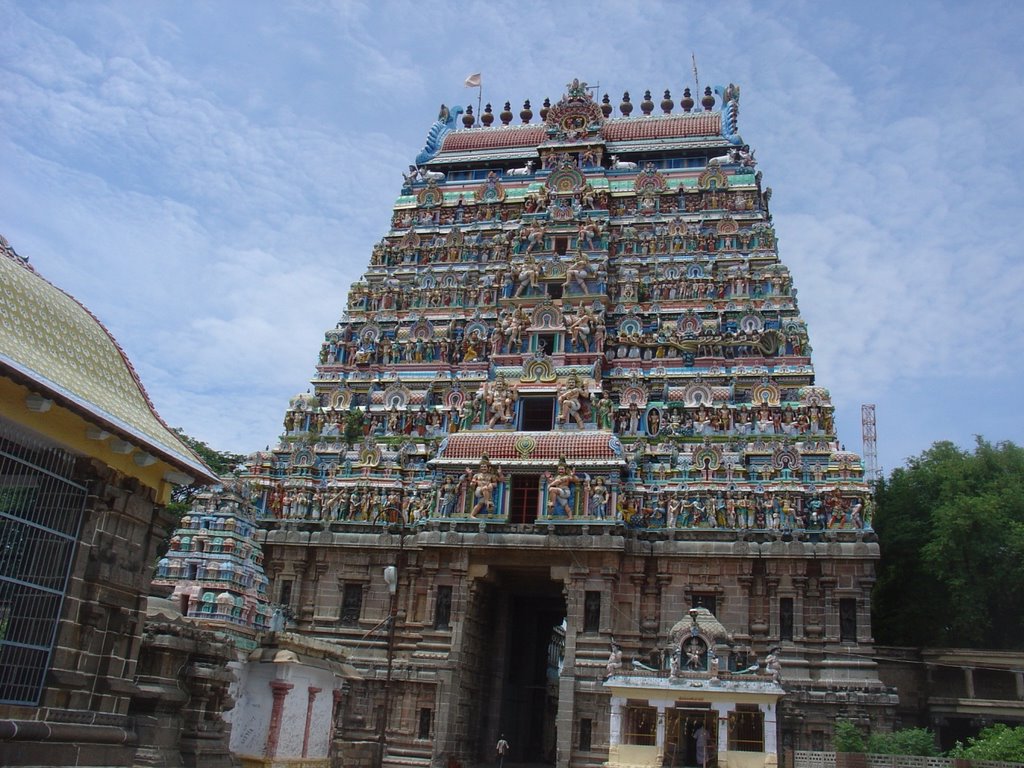
Thillai Natarajar Temple, Chidambaram or Chidambaram temple is a Hindu temple dedicated to Lord Shiva located in the town of Chidambaram, Cuddalore District, East-Central Tamil Nadu, South India. The temple is known as the foremost of all temples to Saivites and has influenced worship, architecture, sculpture and performance art for over two millennium. The Sangam classics list chief architect Viduvelvidugu Perumthachchan as directing an early renovation of the shrine.
A major shrine of Lord Shiva worship since the classical period, there have been several renovations and offerings to Chidambaram by the Pallava, Chola, Pandya, Vijayanagara and Chera royals  in the ancient and pre-medieval periods. The temple as it stands now is mainly of the 12th and 13th centuries, with later additions in similar style. Its bronze statues and stone sculptures depicting various deities and the famous Thillai trees of the surrounding forest reflect the highpoints of early Chola and Pallava art while its famed gold plated gopuram towers are medieval structural additions by the royals Aditya I, Parantaka Chola I, Kopperunchinga I, Krishnadevaraya and Jatavarman Sundara Pandyan. King Kocengannan Chola was born following prayers his parents offered at the temple and later in his life he refined its structure. The shrine gave the town its name.
The deity that presides here is Thillai Koothan (Thillai Nataraja - Shiva, The Lord of Dance). Chidambaram is the birthplace of the sculpture and bronze image representation of Lord Shiva as the cosmic dancer, a Tamilian concept and motif in Chola art that has since become notable as a symbol of Hinduism. The shrine is the only Shiva temple to have its main deity represented in this anthropomorphic form, as the supreme being who performs all cosmic activities. The consort deity here is Sivakami Amman (form of Amman - mother goddess and female energy). Two other forms of Lord Shiva are represented close to this in the vimana (inner sanctum) of the temple - as a crystallised lingam - the most common representation of Lord Shiva in temples, and as the aether space classical element, represented with empty space and a garland of fifty one hanging golden bilvam leaves (Aegle marmelos). Lord Shiva is captured in pose as Nataraja performing the Ananda Tandava ("Dance of Delight") in the golden hall of the shrine Pon Ambalam (பொன் அம்பலம்). The sculptures of Chidambaram inspired the postures of Bharatha Natyam. The Chidambaram complex is admired for its five famous halls (ambalam or sabhai), several grand smaller shrines to the Hindu deities Ganesh, Murugan, Vishnu and Sivakami Amman which contain Pandyan and Nayak architectural styles, and for its endowment from many water tanks, one of which links it to the Thillai Kali temple.
Chidambaram is one of the five Pancha Bootha Sthalams, the holiest Shiva temples each representing one of the five classical elements; Chidambaram represents akasha (aether). Chidambaram is glorified in Tirumular's Tirumandhiramand was visited by Patañjali and VyagjrapadharPulikaal Munivar. It is the primary shrine of the 275 Paadal Petra Sthalams - Shiva Sthalams glorified in the early medieval Tevaram poems by Tamil Saivite Nayanar saints Tirunavukkarasar, Thirugnana Sambandar and Sundarar. Hailed in the Tiruvacakam series by Manikkavacakar, these very volumes of the Tirumurai literature canon were themselves found in secret chambers of the temple. The Periya Puranam, a biography of these Nayanar saints by Sekkizhar commissioned by emperor Kulothunga Chola II, was written in the shrine's Thousand Pillared Hall. In Kanda Puranam, the epic authored by Kachiyappa Sivachariar of Kanchipuram, the Chidambaram shrine is venerated as one of the three foremost Shiva abodes in the world, alongside Koneswaram temple of Trincomalee and Mount Kailash.


Temple


The temple complex spread over 50 acres in the heart of the city. It is an ancient and historic temple dedicated to Lord Shiva Nataraja and Lord Govindaraja Perumal, one of the few temples where both the Shaivite and Vaishnavite deities are enshrined in one place.To the followers of Shaivism (Saivism) or the saivaite, the very word koil refers to Chidambaram. In the same way, to the followers of Vaishnavism it refers to Srirangam or Thiruvarangam.
West Tower

Meaning of Chidambaram
The word Chidambaram may be derived from chit, meaning "consciousness", and ambaram, meaning "sky" (from aakasam or aakayam); it refers to the chidaakasam, the sky of consciousness, which is the ultimate aim one should attain according to all the Vedas and scriptures.Another theory is that it is derived from chit + ambalam. Ambalam means a "stage" for performing arts. The chidakasam is the state of supreme bliss or aananda and Lord Natarajar is the symbolic representation of the supreme bliss or aananda natanam. Saivaites believe that a visit to Chidambaram leads to liberation.Yet another theory is that it is derived from the word chitrambalam, from chithu meaning "play or dances of God" and ambalam meaning "stage"

The Ananda Tandava Posture
The Ananda Tandava posture of Lord Shiva is one of the famous postures recognized around the world by many. This celestial dancing posture tells us how a Bharathanatium Dancer should dance.

The demon under Nataraja's feet signifies that ignorance is under his feet 
The Fire in this hand (power of destruction) means destroyer of evil 
The raised hand signifies that he is the savior of all life. 
The Ring at the back signifies the cosmos. 
The drum in his hand signifies the origin of Life. 

These are the main things that the Natarajar murti and the celestial dance posture depict. A rare type of thandava posture is seemed in Melakadambur temple near by 32 km from here.In this Karakoil, Nataraja dancing on a bull and deva's rounds the structure it's an pala art being kept in this shrine

Significance

Chidambaram is also referred to in various works such as Thillai (after the Thillai forest of yore in which the temple is now located), Perumpatrapuliyur or Vyagrapuram (in honour of Saint Vyagrapathar).The temple is supposed to be located at the Lotus heart of the Universe": Virat hridaya padma sthalam. On the spot where the Lord displayed his dance of bliss, the Änanda Thaandavam - a spot exactly south of the "Thirumoolataaneswar temple", today is the Ponnambalam/ Porsabai (Pon meaning gold, Ambalam/Sabai meaning stage) housing the Lord Shiva in his dancing form. The Lord is also hence referred to as the Sabhanayakar, meaning the Lord of the Stage.

This gold-roofed stage is the sanctum sanctorum of the Chidambaram temple and houses the Lord in three forms:
the "form" - the anthromorphological form as an appearance of Lord Nataraja, called the Sakala thirumeni. 
the "semi-form" – the semi-anthropomorphological form as the Crystal linga of Chandramouleswarar, the Sakala nishkala thirumeni. 
the "formless" – as the Space in Chidambara Rahasyam, an empty space within the sanctum sanctorum, the Nishkala thirumeni. 

Sacred Heart Shrine/Church, Idaikattur, Sivagangai

Sacred Heart Shrine/Church is located in Idaikattur, a village panchayat in Sivaganga district in the Indian state of Tamil NaduThis unique church of the sacred heart of Jesus was built in 1894 AD by a French missionary Fr. Ferdinand Celle SJ. This is a replica of the Rheims Cathedral in France. Since the church was said to be built by angels, Fr. Ferdinand Celle SJ has placed 153 depictions of angels in and around the church He has depicted the relics of forty saints in four elliptical shaped wooden bowls, which rest over the wooden heart in the main altar portion. We pray for all the devotees of the sacred heart continuously through these heavenly beings.

Sacred Heart Shrine at Idaikattur
         Although the sacred heart shrine at Idaikattur is a replica of the Rheims cathedral in France, It has some unique features It is constructed with 200 different types of moulded bricks and tiles in lime martyr. They are used for its decoration. The inner Gothic arches rest over the columns embedded with ribs its corner rising up to the vaulted roof. The windows are decorated with small brick pillars adjoined with hallow flower bricks and stained glass works which depicts the events of the way of the cross colourfully and beautifully. Since south India is a tropical country utilization of the hallow bricks in the construction reduces the heat and also there is a vacuum gap between inner vaulted roof makes an air-conditioned system below the shelter of the wall. The stucco figures and the statues of saint, angels and the sacred heart of Jesus, his foster father St. Joseph and the Holy family statue with golden gilt and the mother of sorrows are of great beauty and symbol of ancient French art work. Historical events of the conversion given by St. John de Britto to Kattayadevan, son-in-law of Kilavan Sethupathi king from Hinduism to Christianity and de Britto's sentence of death by king Kilavan Sethupathi are depicted in stained glass work on northern and southern entrance facade. The main altar of the church is more beautiful with gigantic Gothic facade of 45 feet high with stucco figures of God the father holding His only crucified son Jesus by his hands and the holy spirit proceeding from his chest surrounded by angels in clouds and in the glittering gold rays of the sun around the whole work are relief from the wall. This main altar depicts the doctrine of the Christianity i.e., the Father, the Son and the Holy Spirit are in one and the same clearly shown to all people who look at it. The Gothic arches are decorated with rows of beads, flowers, garlands. They all are in terracotta works.

Pascaa - The Greatest Stage Drama Forever
          Pascaa is a Festival that was celebrated by the Israel people in ancient days. Pascaa means crossing past. Here in Idaikattur, this festival is being celebrated for two days by the villagers on the next Friday and Saturday of the Good Friday, every year, for the past 139 years. In this event, the Life history of Jesus is staged as a drama, up to the death of Christ on the first day and up to the ascension on the second day.
The whole drama was scripted from Bible by a group of uneducated villagers, called " ANNAVIYAR" and the dialogues are never changed for this 3 generations which coincide anywhere and anytime in the common life. Based on the ancient Tamil cultural dramas of Tamilnadu, this epic attracts tens of thousands of people from across the country. The lyrics of the songs of the drama which were penned by the same Annaviyar, composed with a mixture of western and classical music before 139 years, are proved as the best classicals of the two centuries.
The artists,numbering to a 100, are all the nativities of the village, inherit the ancient farmers of the village, who are in high positions of the society gather on this particular dates in the village from all over the world to submit themselves to the Sacred Heart of Jesus of Idaikattur.
The whole programme is a citadel for all the villagers apart from their religion and community.
The 139th year of pascaa is scheduled on 1st and 2nd of April, 2016.
The proposal for the Guinness record is also submitted and is in process.